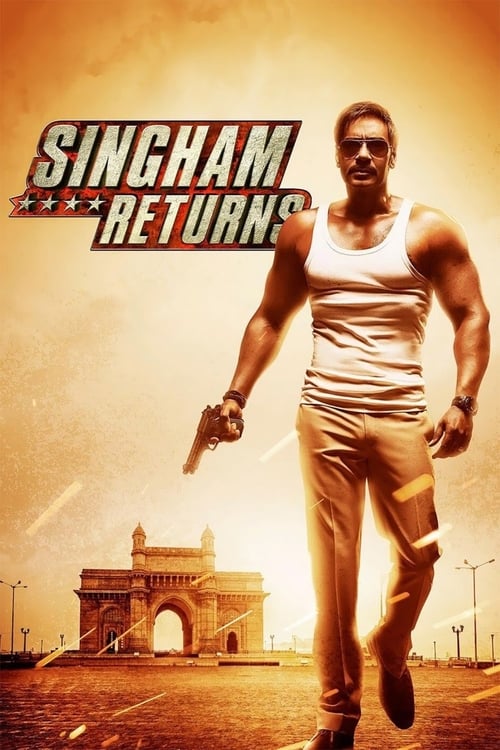
📊 CRITICS AND AUDIENCE SCORES
Singham Returns Review: Rohit Shetty’s High-Octane Sermon on Justice and Populist Rage
When Bajirao Singham steps out of a swirling vortex of dust, accompanied by a thunderous, Sanskrit-infused background score, it isn’t merely an entrance; it is a celluloid exorcism of middle-class anxiety. Released on the symbolic canvas of Independence Day in 2014, Rohit Shetty’s Singham Returns arrived at a socio-political flashpoint in India. The nation was grappling with systemic fatigue, anger against bureaucratic paralysis, and the corrosive influence of black money. In this landscape, Ajay Devgn’s titular character returned not just as a Deputy Commissioner of Police, but as the ultimate blue-collar savior—a roaring, khaki-clad deity tasked with cleansing the Aegean stables of political corruption.
Unlike its 2011 predecessor, which focused on localized feudal tyranny in Shivgarh, Singham Returns shifts its battleground to the sprawling, rain-slicked concrete jungle of Mumbai. This geographical transition alters the film’s DNA. The sequel swaps rustic melodrama for a gritty, procedural-adjacent conspiracy thriller, albeit one wrapped in Shetty’s trademark aesthetic of flying cars and gravity-defying machismo. It is a film that operates on pure, kinetic adrenaline, presenting a fascinating study of how mainstream commercial cinema packages populist anger into two hours of cathartic violence.
—
The Narrative Engine: Black Money and the Pulpit of Patriotism
The plot of Singham Returns is deceptively simple but structurally heavy. It follows DCP Bajirao Singham as he investigates the suspicious death of a young, honest police constable discovered in an ambulance laden with bags of unaccounted cash. This tragedy leads Singham directly into a web of political deception spun by the insidious alliance between a fraudulent spiritual guru, Swami Ji (played with theatrical menace by Amole Gupte), and a corrupt politician, Prakash Rao (Zakir Hussain). Standing as the sole moral beacon against this alliance is the idealistic political reformer Guruji (Anupam Kher), whose vision for a clean democracy makes him an immediate target for the status quo.
What elevates the narrative beyond a standard cops-and-robbers chase is its thematic preoccupation with “black money”—the shadow economy that funds political campaigns and cripples national progress. Shetty and his screenwriters tap directly into the zeitgeist of the early 2010s anti-corruption movements. The film positions the police force not as a tool of state oppression, but as the last line of defense for the common citizen. It is a cinematic fantasy where the systemic delays of the judiciary are bypassed in favor of instant, righteous retribution on the streets of Mumbai.
—
Ajay Devgn’s Gravity vs. Rohit Shetty’s Gravitational Defiance
The Stoic Might of Bajirao Singham
At the center of this storm is Ajay Devgn, whose performance remains the anchor that prevents the film’s bombast from drifting into self-parody. Devgn possesses a unique, volcanic screen presence; his eyes convey a silent, simmering fury before his fists ever make contact. Where other action heroes rely on hyperbolic dialogue delivery, Devgn underplays Singham’s authority. He carries the weight of the uniform with a somber dignity, making his eventual outbursts—marked by the iconic “Aata majhi satakli”—all the more explosive. His physicality is grounded, making the punishing action sequences feel earned rather than gratuitous.
The Architecture of Rohit Shetty’s Action
Director Rohit Shetty is often criticized for his reliance on explosive spectacle, but to dismiss his craft is to misunderstand the grammar of Indian mass action cinema. In Singham Returns, Shetty refines his visual style. The action is cleaner, the editing is sharper, and the use of the Mumbai landscape—particularly the iconic Bandra-Worli Sea Link—is spectacular. Shetty treats his action sequences like musical numbers, orchestrating choreography, slow-motion framing, and vehicle pyrotechnics into a symphony of destruction. It is a hyper-real universe where Scorpio SUVs flip in perfect synchronicity, yet within the logic of the film, it feels entirely natural.
—
Performative Balance: From Demagoguery to Comic Relief
The supporting cast of Singham Returns offers a stark contrast of textures. Amole Gupte, as the duplicitous Swami Ji, delivers a performance bordering on the operatic. He is a caricature of religious hypocrisy, yet Gupte plays him with such greasy, manipulative relish that he becomes a thoroughly hateable antagonist. Conversely, Anupam Kher brings a quiet, tragic dignity to the film as Guruji, representing the dying light of Nehruvian idealism in a world of cutthroat realpolitik.
However, the film stumbles slightly in its attempt to balance grim political reality with commercial levity. Kareena Kapoor Khan, playing Singham’s love interest Avni Kamat, is relegated to a manic-pixie comic-relief archetype. While her effervescence offers a breather from the film’s otherwise tense atmosphere, her subplots—centering on dietary anxieties and misunderstandings—often feel like they belong to a completely different movie. Despite this, her chemistry with Devgn remains warm and affectionate, grounding the fierce cop in a domestic reality.
Special mention must be made of the ensemble cast playing the police department, particularly Dayanand Shetty (of CID fame) as Inspector Daya. His inclusion is a delightful nod to Indian television pop culture, and his door-breaking prowess is utilized to maximum cinematic effect, eliciting cheers from the gallery.
—
Director Rohit Shetty’s Visual Signature and the Genesis of a Universe
To understand the significance of Singham Returns, one must look at Rohit Shetty’s broader filmography. This film marks the crucial transitional phase where Shetty evolved from a director of disparate blockbusters into the architect of India’s first cohesive cinematic universe.
- The Cop Universe Blueprint: While 2011’s Singham was a standalone remake of a Tamil hit, Singham Returns was engineered as an original property designed to scale. It laid the narrative and stylistic groundwork for what would eventually welcome Simmba (Ranveer Singh) and Sooryavanshi (Akshay Kumar).
- The Maturation of Style: Moving away from the saturated, hyper-colorful palette of the Golmaal series, Shetty adopts a cooler, steel-grey and blue color grading in this sequel. The rain-drenched streets of Mumbai provide a moody, noir-lite backdrop that suits the film’s darker themes of political assassination and financial fraud.
- A Musical Manifesto: The soundtrack, particularly the roaring title track by Meet Bros Anjjan and the high-energy “Aata Majhi Satakli” by Yo Yo Honey Singh, served as powerful marketing tools that amplified the film’s populist appeal.
—
Singham Returns: Key Production Details & Cast
| Aspect | Details |
|---|---|
| Director | Rohit Shetty |
| Lead Cast | Ajay Devgn, Kareena Kapoor Khan, Amole Gupte, Anupam Kher, Dayanand Shetty |
| Release Date | August 15, 2014 (Independence Day) |
| Genre | Action / Political Thriller |
| Cinematography | Dudley |
| Key Themes | Anti-Corruption, Black Money, Police Reforms, Vigilante Justice |
—
The Verdict: A Masterclass in Mass-Entertainer Filmmaking
Ultimately, Singham Returns is a roaring success of its genre. It doesn’t pretend to be an intellectual deconstruction of Indian politics; instead, it is a visceral, emotionally satisfying punch to the gut of systemic corruption. It validates the anger of the common man, offering a cinematic oasis where justice is swift, incorruptible, and delivered with a resounding slap.
Through the lens of film scholarship, the movie stands as a testament to Ajay Devgn’s enduring legacy as an action icon and Rohit Shetty’s unparalleled understanding of the Indian mass pulse. It is loud, it is unapologetic, and it is executed with a level of technical precision that commands respect. For fans of high-octane Bollywood action, Singham Returns remains a modern gold standard—a film where the roar of the lion is matched only by the roar of the audience.

📁 PRODUCTION DETAILS & BOX NOTES
| Title Name | Singham Returns |
|---|---|
| Director | Rohit Shetty |
| Release Date | 2014-08-15 |
| Running Duration | 142 mins |
| Primary Genres | Action |
| Studio Budget | $13,000,000 |
| Production Labs | Reliance Entertainment, Ajay Devgn FFilms |
🌟 METROPOLITAN CAST & ROLES







[review_advertinement_space freq=’medium’]
❓ FREQUENTLY ASKED QUESTIONS SUMMARY